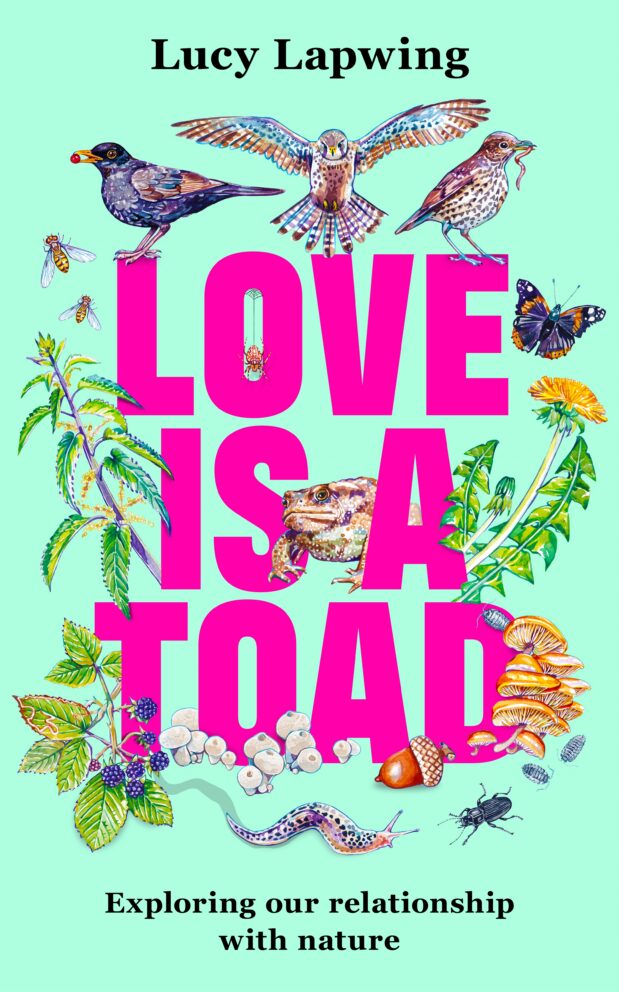
In her luminous, lyrical debut Love Is a Toad, wildlife campaigner and broadcaster Lucy Lapwing traverses meadows, bogs and hedgerows with her fellow nature enthusiasts, and digs down into our relationship with the natural world.
With many of us set to venture into the outdoors this long weekend, take inspiration from this short excerpt – as Lucy and Nadia define the two types of ‘nature joy’…
Stopping to squeeze through a kissing gate, I spied a curled black sausage nestled in the grass at my feet. ‘Bloody hell, you chonks!’ Nadia bent down for a closer look and I crouched next to her. Plump and chubby and adorned with protruding hairs, it was a sizeable caterpillar – the length and thickness of my pinky. I gently scooped it up, moving it out of the way of any more boots, and it coiled up softly in the palm of my hand. It felt like velvet and sat with a surprising heftiness – chunky and solid. Its dark body was mottled with molten orange speckles and, combined with its whorled posture, it looked somewhat cosmic – a bit like a photograph of a swirling galaxy. I recognised it as the caterpillar of the Drinker (what a name) – a big caterpillar that becomes a big moth, fluffy and ginger and slightly reminiscent of a puppy. We took a moment to indulge in admiration – our noses only inches from the coil of speckles and hairiness. A deep, satisfying sigh, a minute of unfocused bliss. It was all rather relaxing.
I asked Nadia about it – if this sort of moment is when she finds she’s in her element of nature joy. ‘God, yes – if I’m out on my own, wandering without purpose, without any constraints on time. And obviously if I’ve got a good packed lunch . . .’ Nadia trailed off. We mutually understood the importance of packing some good butties for a long walk.
‘It’s those days you spend slowly exploring. Seeing what happens around you and being surprised by your own ability to get lost in something. Some kind of archetypal British moment: a hot summer’s day lying in a meadow, watching insects fly past, or going rock pooling, or one of those crisp, misty mornings in autumn. All of these little private moments.’
I could picture each of the scenes as she spoke, seeing a Nadia in a state of tranquillity and peacefulness. We squelched along, wobbling across the muddiness underfoot and the wetness of spring. A small burn, trickling vigorously, intersected the path in front of us and a rickety footbridge saved us from having to go for a paddle. The water flowed steadily; with all the rain, it had swollen up and over its narrow banks, combing the grass either side like parted hair.
Nestled in the green and submerged under the flow was a sliver of grey. I plucked the sopping feather from the stream and preened it softly with my fingers, arranging the barbs and tidying its edges to reveal its identity. A pale, smoky grey, punctuated by blurred bars the colour of storm clouds, with a band of cream down the left side: I held in my fingers a feather dropped by a Sparrowhawk. How cool and how apt. The Beech hedges had opened out into a spacious corridor, flanked each side by Birch scrub and Gorse bushes. I’d already given it a nickname on previous walks – Sparrowhawk Alley. It seemed to be a favoured place for these avian annihilators. I’d regularly seen one zooming silently and determinedly along the open ride, on the tail of the Chaffinches we’d seen earlier. As we continued to walk, I kept an eye out for the telltale shadow, the flap-flap-glide, but there was no sign. The alleyway was quiet today.
I handed the feather to Nadia and she twirled it in her fingers, admiring its stripes and paddle-like form. ‘For me, nature joy comes in two types,’ she mused. ‘There’s Type One – those moments which are really acute and explosive. Like seeing that Humpback – it was an uncontained, unadulterated, unfiltered joy!’ Ahh. The whale. I think about it often and smile every time I do. ‘Type One moments are those when you identify or recognise something, and you’re just absolutely buzzing. I’ll either scream and be silly, or I’ll just cry. It’s a rush that’s so heavy. It’s, like, observer joy.’
Observer joy – those moments of wow, when you recognise a species and you know exactly what it is or why it’s doing what it’s doing. It could be when you see something you’ve read about in books or heard other people excitedly discuss. I’ve had plenty of experiences that fit into this type. Like the time I’d got lost in some woods and in trying to take a shortcut back to a path had slipped into a ditch. With sog seeping into my knickers, I realised I’d stumbled across something awesome: a small, vivid-orange matchstick of a mushroom, my first ever Bog Beacon Fungus. I’d seen pictures of it in a mushroom book and fantasised about meeting it for a couple of years, and here it was, glowing against the gloom of the dark water like a little lighthouse. I was ecstatic. Or there was the time I first saw Ivy Bees. I’d climbed up on to the rickety shed roof in my back yard to get a closer look at the stripy bums I could see zooming about and one momentarily landed, looking just like the pictures I’d seen online. So exciting.
By now, we’d traversed a little further along the West Island Way, passing from Sparrowhawk Alley to Gorse Avenue.
Here the path was squeezed by Brambles and Gorse, which grappled at our jackets as we pushed through. I pinched a couple of flowers from a vibrant Gorse bush and nibbled on them, relishing the pungent combination of planty bitterness and coconut. The weighty, plump clouds above had started to release chunky droplets of rain that quickly soaked us, our socks soggy and a constant trickle running down our foreheads and noses.
Nadia continued her train of thought, licking her lips in between to catch raindrops. ‘Then there’s Type Two. Exquisite nature joy. It’s totally different. Like getting into a warm bath. It’s a completely different high, almost transcendental.’
As the avenue opened up into a waterlogged field of Soft Rush, the towering mountains of Arran appeared in the distance, jagged and dramatic and partly obscured by pillowy clouds. Scattered across the field were white pompoms of Cotton Grass, static and bob-less on such a still day. It was tranquil, the gentle pattering of rain continued and the smell it left, also infused with the earth and vegetation, hung heavy around us.
‘Type Two is when you feel it in your body. When it seeps in, when it becomes part of you. To be salty-skinned, or when your hands smell like crushed leaves, or you feel the rain pouring down your face.’ She laughed, experiencing the latter as she spoke. ‘I guess it’s the moment when you transition from civilised human into something more creature-like.’
To be creature-like. That was exactly it. I’d never thought about it this way before. Type Two definitely feels like something tangible and distinct. To fully sink into the animalistic side of oneself and simply be in a habitat, a dynamic bundle of nerves and senses and processing. Sniffing stuff, watching stuff, licking stuff. It’s there in those long, quiet moments when you find a spot – a tree, a pond, a bench – and hunker down, settling into a state of stillness and softness. When you melt into the background and let nature carry on around you. When I find myself in this state, I can feel it physically, a twinkling and sparkling sensation, sitting behind my eyeballs somewhere deep inside my skull, like goosebumps of the brain. I feel it in my chest too – a deep, satisfying ache, like the sweet spot at the top of a stretch. In these moments every sense is heightened, eyes wide, lungs full, skin tingling. It might be autumn sunlight dappling through a fiery canopy of Oak and Beech. It might be the thrum and buzz of a meadow in summer, the perfect pose of a bumblebee upon some Knapweed. It could even be a barefoot beach walk in midwinter, aching toes and bubbling Curlew and the hisssss of the waves through pebbles and sand. In these moments there are no rigid, human-language thoughts. In these moments I don’t matter. In these moments everything makes sense.
Lucy Lapwing’s Love is a Toad is out now with Blink. Learn more about the book and find links to get your copy here.